Burgundy’s Fight Against Spring Frost
By Chilled Magazine


The image shown here looks beautiful-perhaps even romantic- but it is every winegrower’s nightmare. It’s springtime on the pristine, sloping vineyards of Burgundy, one of France’s most renowned wine regions, known for its world-class Chardonnay and Pinot Noir.
Winter pruning has been completed over the last two months, and eagerness for the next phase of the vine’s growth emerges with warmer temperatures.
However, with eagerness comes trepidation. Temperatures rarely follow the calendar, and a sudden drop can spell disaster. Frost is the ever-present fear in the heart of every winegrower. Northern France is facing this volatile reality right now, as this very scenario is playing out threatening this year’s vintages.
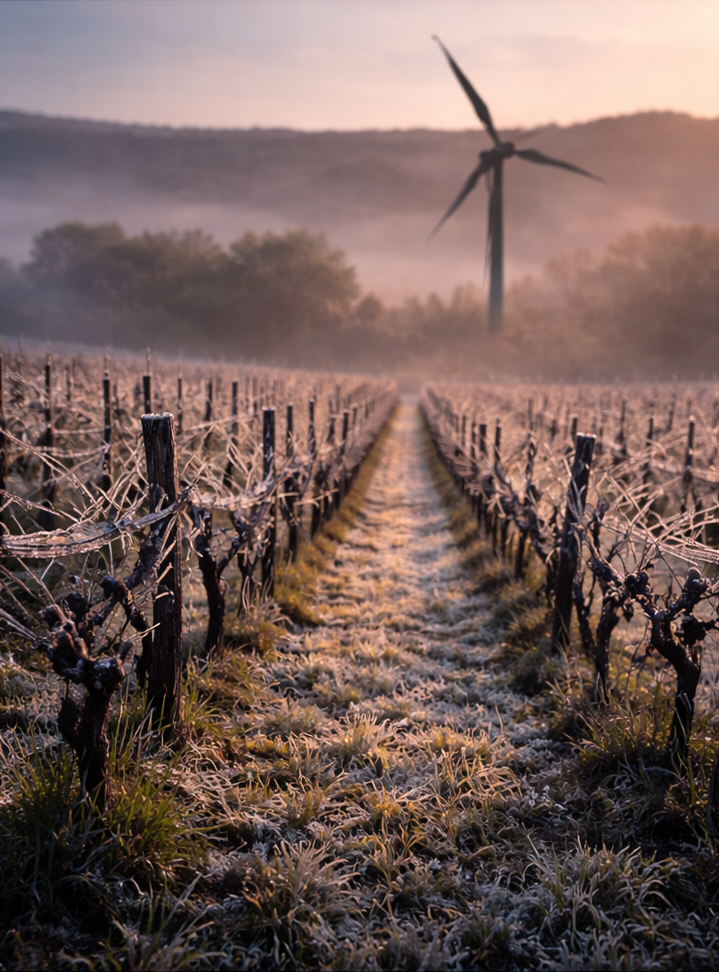
Spring frost damage to grapevines is an enduring challenge in viticulture, particularly in the northern wine-making regions where vines awake from dormancy and just as temperatures can plunge below freezing. Although these regions have battled spring frost for centuries, the stress of potential vine loss and its ripple effect on production and sales is a constant worry for the vignerons.
The earliest documented methods of preserving vines from frost date back to 2000 years ago to the Romans, who lit fires with pruned wood and dead vines placed between the rows. In the early 20th century, Europeans expanded on this practice by using straw or hay bales to create a smoke blanket. That approach evolved into today’s smudge pots or heaters—metal buckets filled with oil, paraffin, or diesel. More efficient than open fires, they are still labor-intensive and are costly to operate and maintain.
With these “smoke machines” the thick smoke is the real hero: it acts like a low cloud ceiling, trapping warmth near the ground preventing the vineyard from radiating heat away into space on clear, calm evenings.
In the 1930s, wind machines gained popularity for their relative cost-effectiveness. These large fans pull warmer air from above and circulate it downward mixing it with the colder air near the ground, which became another strategical tool for winegrowers’ ongoing battle against the elements.

By the 1940s innovation and science introduced overhead sprinkler systems that harness the latent heat released when water freezes. While the method may sound counterintuitive, it is highly effective. As sprinklers coat the vine with a fine mist, an “ice cocoon” forms around the bud and shoots. The freezing water releases heat on the surface, holding the critical temperature at exactly 0 °C (32 °F) protecting the living tissue inside. This requires roughly 1,000 gallons per acre per hour.
Today, many vineyards employ the use of infrared heaters, electromagnetic systems, and heated cables that run along the vines where budgets allow. Success depends on accurate weather monitoring, timely activation, reliable forecasting, and most importantly the grower’s determination to persevere—no matter the cost.
The work is grueling, sometimes heartbreaking, yet deeply rewarding. As Ernest Hemmingway observed in A Moveable Feast, “In those days spring always came finally, but it was frightening because it almost failed.”
Share This Story, Choose Your Platform!